Plenty of people who move to Dubai end up buying. The city sells freehold homes to foreigners outright, the taxes are famously light, and a purchase can even open the door to a long-stay visa. But the rules look nothing like they do back home. Buying property in Dubai means a stack of one-off fees on top of the price, a choice between off-plan and ready, mortgage caps set by the Central Bank, and a transfer done in person at a government trustee office. Get it right and you own a home in a few weeks. Get it wrong and you overpay or tie your cash up in the wrong deal. We built Eric, a WhatsApp assistant that helps people find Dubai homes, so we hear these questions every day. This guide answers them in plain language: what it really costs, where foreigners can own, off-plan versus ready, how mortgages work, the process step by step, and how to dodge the traps.
This is general information, not financial advice, not legal advice and not immigration advice; always speak to a licensed professional before you act.
What buying property in Dubai costs
Buying property in Dubai costs more than the sticker price, because a stack of one-off fees lands on completion day and almost all of it has to be cash. The headline is the Dubai Land Department transfer fee, and around it sit a handful of smaller charges. Here's the picture in 2026.

| Cost | Typical amount | Who pays |
|---|---|---|
| DLD transfer fee | 4% of the price | Buyer, in practice |
| Registration (trustee office) | 4,000 AED + 5% VAT | Buyer |
| Agent commission | 2% of the price + 5% VAT | Buyer, on resale |
| Mortgage registration | 0.25% of the loan | Buyer, if financing |
| Developer NOC | 500 to 5,000 AED | Buyer |
| Title deed issuance | 580 AED | Buyer |
Add it up and you should budget roughly 7 to 8 percent of the price on top, in cash, before anyone hands you a title deed. The 4 percent transfer fee is the big one. On paper the law splits it evenly between buyer and seller, but in practice the buyer pays the whole 4 percent, and most contracts say so.
My blunt advice: these fees cannot be rolled into a mortgage, so have your deposit plus the fees liquid before you make an offer. The best deals go to buyers who can complete without scrambling for cash.
Where foreigners can buy: freehold vs leasehold
Buying property in Dubai as a foreigner comes with one rule you have to learn first: you can own freehold, but only in designated areas. This is set out in Law No. 7 of 2006 and its Regulation No. 3 of 2006, which name the zones where non-nationals may own.
Freehold means full ownership with no time limit, including a share of the land, and it's what makes you eligible for the property Golden Visa. Outside the designated zones, foreigners are usually limited to leasehold or usufruct, a long lease of up to ninety-nine years rather than outright ownership. The freehold list started at roughly two dozen communities and has since expanded to cover most of the areas buyers actually want.
| Freehold | Leasehold | |
|---|---|---|
| Ownership | Outright, no time limit | Long lease, up to 99 years |
| Where | Designated freehold zones | Most other areas |
| The land | You own a share | Landlord keeps it |
| Golden Visa | Can qualify | Usually not |
The practical takeaway is simple. Almost every popular expat community is freehold, but always confirm the title type before you fall for a place, because a bargain in the wrong zone may not be yours to own outright.
Off-plan vs ready: the two ways to buy
Buying property in Dubai splits into two very different journeys: off-plan, bought straight from a developer before it's built, and ready, a completed home you can walk through today. Neither is universally better, so weigh them against your own timeline and cash flow.
| Off-plan | Ready | |
|---|---|---|
| Entry price | Often lower | Full market price |
| Payment | Staged over the build | Financed or paid at transfer |
| Move-in | Wait for handover | Immediate |
| Main risk | Delay or delivery risk | What you see is what you get |
| Mortgage cap | Up to 50% | Up to 80% on a first home |
Off-plan buyers get a real legal safeguard. Under Law No. 8 of 2007, a developer must hold your payments in a project escrow account regulated by the Dubai Land Department, released only against verified construction milestones, and Law No. 13 of 2008 records your purchase on the interim register through the Oqood system. That doesn't remove the risk of a delay, but it stops your money simply vanishing. Ready homes skip all of that: you buy something finished, transfer it, and move in.
How mortgages work for buyers in Dubai
Getting a mortgage when buying property in Dubai is open to expats, but the Central Bank caps how much you can borrow, so your deposit is larger than you may be used to. The rules turn on whether it's your first home and what it's worth.
For a first home valued at or below 5 million AED, you can borrow up to 80 percent, meaning a 20 percent deposit. Above 5 million AED the deposit rises to 30 percent. A second property, or an off-plan purchase, needs more down again under current Central Bank rules, commonly around 40 and 50 percent respectively. Remember that the transfer fees sit outside the loan and always come from your own pocket.
My honest steer: get a mortgage pre-approval before you start viewing. It tells you your real ceiling, and it lets you move fast when the right home appears, which in this market is half the battle. Rates and terms differ between banks, so it's worth comparing, and a licensed mortgage broker can do that legwork for you.
Where to buy: choosing your community
Choosing where to live is the biggest decision in buying property in Dubai, bigger than the fees on any single deal. The city is a set of very different neighbourhoods stitched together by highways, and the one you pick shapes your commute, your budget, and how easily the place resells or rents later.
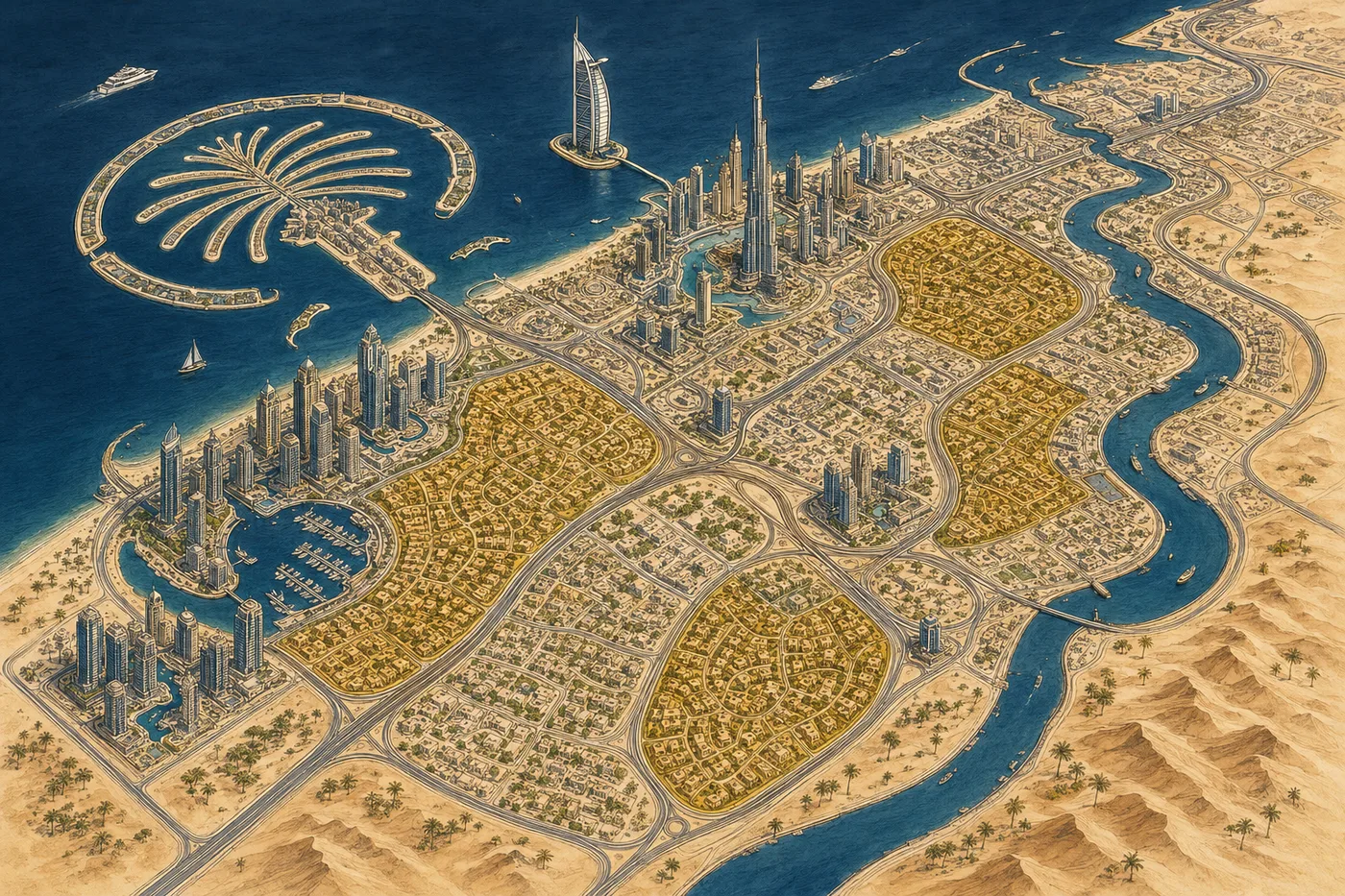
| Community | Best for | Price tier |
|---|---|---|
| Downtown Dubai | Icon status, walkable centre | Premium |
| Dubai Marina | Waterfront apartment lifestyle | Premium |
| Palm Jumeirah | Trophy beachfront living | Ultra-prime |
| Business Bay | Central, new-build towers | Mid to premium |
| JVC | Value and rental yield | Affordable |
| The Springs | Family villas and schools | Mid |
| Dubai South | Space per dirham | Affordable |
Two flats in the same tower can differ by twenty percent, so treat those tiers as a rough map and always check live listings before you set a budget. If you want the trade in detail, our guides for Dubai Marina and JVC break down real prices and lifestyle side by side.
My honest take after watching thousands of searches: buyers over-index on the famous names and pay a premium for a postcode. The quieter, newer communities often give you more home for the money and a stronger rental yield if you ever let the place out.
The buying process, step by step
The process of buying property in Dubai is fast by global standards, and it runs the same way whether or not you use a mortgage. For a completed home, it comes down to four moves.
First, you agree terms and sign a Memorandum of Understanding, the standard Form F contract, and pay a deposit of around ten percent that the agent holds. Second, the developer or master community issues a No Objection Certificate confirming there are no unpaid charges on the property. Third, both sides meet at a Dubai Land Department trustee office, where you pay the balance and the fees by manager's cheque, and the bank releases the mortgage portion if you have one. Fourth, the department issues a new title deed in your name, usually the same day.
Off-plan runs a little differently. You sign the developer's sales agreement, pay according to the staged plan, and the sale is logged on the Oqood register straight away. Your title deed then arrives at handover, once the home is built and you've inspected it.
Golden Visa, running costs and dodging scams
The last part of buying property in Dubai is what comes after the keys: a possible visa, the bills that keep coming, and the traps to sidestep. Get these right and ownership stays a pleasure rather than a headache.
Start with the upside. Buy a home worth 2 million AED or more and, according to the Dubai Land Department, you can apply for a renewable ten-year Golden Visa. The property can be mortgaged as long as your bank provides a no-objection letter, and you can combine wholly owned properties to reach the figure. It's one reason the two-million mark is such a common target for buyers.
Then the ongoing costs. Every community charges an annual service fee, set per building and submitted through RERA's Mollak system, so you can check it against the official service-charge index before you commit. Unapproved charges are not legally enforceable. On top of that come your DEWA utility bills and, in many towers, a district cooling charge. The Dubai REST app is the quickest place to check the numbers for a specific building.
Finally, the guardrails. Ask any agent for their RERA broker card number early, because licensed agents carry one and a refusal is a red flag. Never pay a deposit before you've viewed a property. Never send money to a personal account instead of an escrow or trustee account. And walk away from any price that sits wildly below everything else in the same building. Real deals survive scrutiny.
Frequently asked questions
How much do I need on top of the price when buying in Dubai?
Budget roughly 7 to 8 percent of the purchase price in cash. When buying property in Dubai you pay a 4 percent Dubai Land Department transfer fee, an agent commission of around 2 percent plus VAT on resale, a registration fee of 4,000 AED plus VAT, a small mortgage registration fee if you're financing, and a developer NOC fee. None of it can be added to a mortgage, so it all has to be liquid.
Can foreigners buy property in Dubai?
Yes. Foreigners can own freehold property, with full and time-unlimited ownership, but only in designated freehold zones set out in Law No. 7 of 2006. Outside those zones, buying property in Dubai as a non-national usually means leasehold of up to ninety-nine years rather than outright ownership. Most popular expat communities are freehold, so check the title type of any specific home before you commit.
Can expats get a mortgage in Dubai?
Yes, though the deposit is larger than in many countries. For a first home valued at or below 5 million AED, the Central Bank lets you borrow up to 80 percent, so you need a 20 percent deposit. Above that value, or on a second or off-plan purchase, you put down more. A key part of buying property in Dubai is remembering that the transfer fees sit outside the loan and must come from your own cash.
Does buying property get me a UAE visa?
It can. Buying property in Dubai worth 2 million AED or more lets you apply for a renewable ten-year Golden Visa, according to the Dubai Land Department, and the home can be mortgaged if your bank gives a no-objection letter. Smaller purchases may support shorter residency routes. Visa rules change, so confirm the current criteria on official government channels before you rely on them.
Is it better to buy off-plan or ready?
There's no single answer, and it depends on your timeline, cash flow and appetite for risk. Off-plan often has a lower entry price and a staged payment plan, and your payments are protected in a regulated escrow account, but you wait for handover and carry delay risk. A ready home costs full market price yet lets you move in, or rent it out, immediately. Weigh both against your own situation rather than a rule of thumb.
For the arithmetic on any particular price, our purchase cost calculator breaks the 4 percent transfer fee, the fees around it and the deposit into the cash you actually need on registration day.
The bottom line
Buying property in Dubai is refreshingly quick once you know the shape of it. Budget for the fees in cash, not just the price. Check that a home sits in a freehold zone if you want to own it outright. Decide honestly whether off-plan or ready fits your timeline, get your mortgage pre-approved before you view, and pick your community for your actual life rather than the postcode.
Do those things and you'll complete on a good home fast, at a fair price, with none of the nasty surprises that trip up first-timers. Renting first while you learn the city is a perfectly sensible move too, and our companion guide to renting in Dubai walks through that side. And if you'd rather skip the midnight portal scrolling, that's the exact problem we built Eric to solve. Tell him what you're after on WhatsApp and get a shortlist of real homes back. Either way, you now know more about buying here than most people who've lived in the city for years. Go find your place.